Why AI Makes ISO 24896 Critical for Bank Reporting


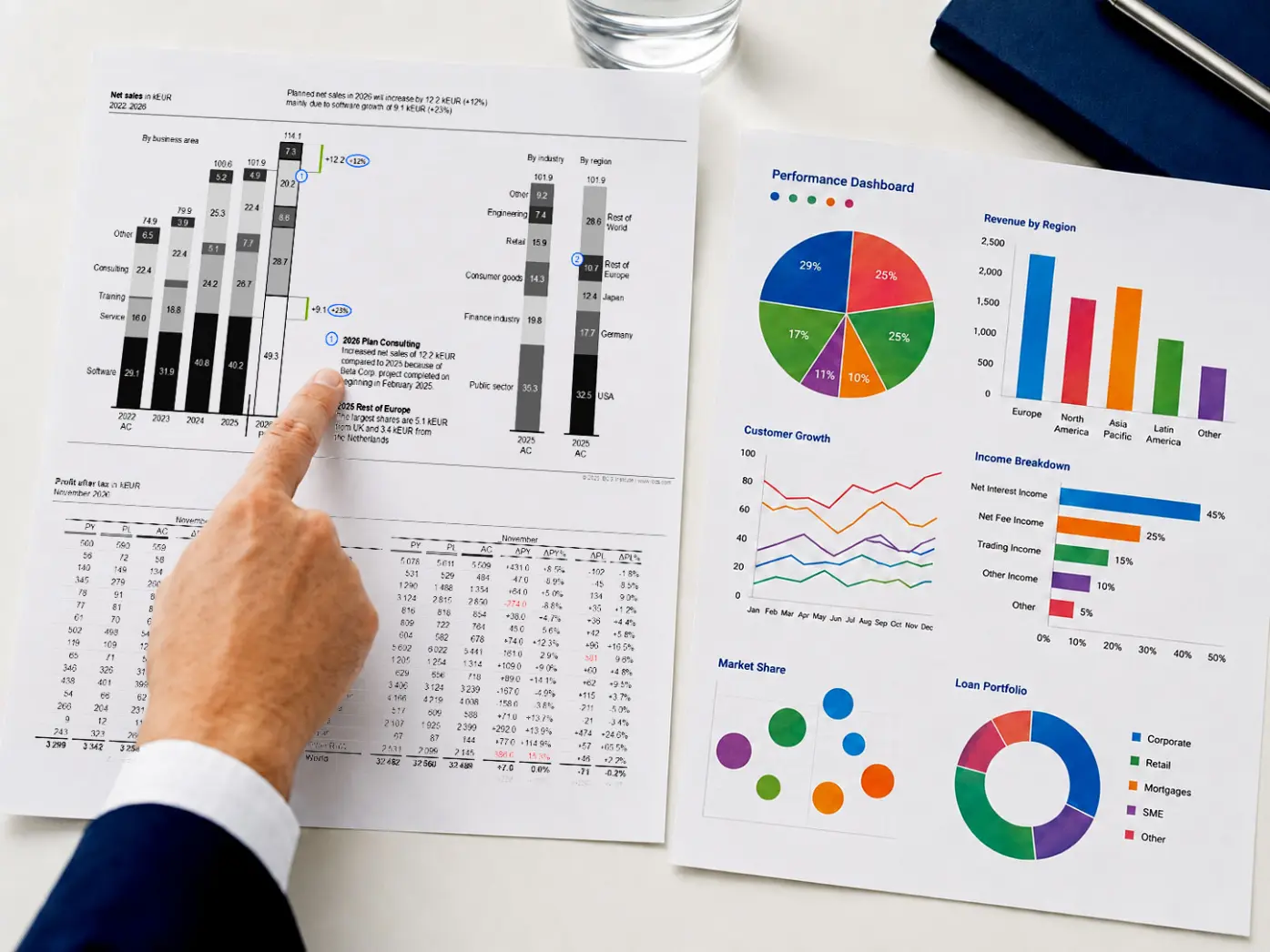
For years, most banks have accepted a quiet inefficiency: every management report, board pack and dashboard looks slightly different. Different colour codes, different axis scales, different ways of showing variance, different table layouts. Analysts spend time decoding the visual language before they can even start analysing the numbers. Decision makers lose speed. Misunderstandings creep in.
I saw this repeatedly during my years in banking. Middle management often used the flexibility in reporting design to shape the narrative, putting preferred messages in focus while keeping certain weaknesses less transparent. The visual language itself became part of the politics.
Today, as co-owner of a small group of companies, I look at reports very differently. I value clarity without agenda. I want the numbers and the story to stand on their own, without visual spin. That shift in perspective is one reason I believe a proper reporting standard matters more than most people still realise.
ISO 24896, published in June 2026, is the first international standard that addresses exactly this problem. It defines a consistent visual notation for business reporting: how charts, tables and key messages should be designed so that the same facts look the same way every time.
This is not about making reports “prettier”. It is about making them faster and safer to understand, and harder to spin.
The Practical Benefits of Standardised Bank Reporting
A standardised notation delivers three concrete advantages:
1. Speed of insight
When the visual language is consistent, readers spend less cognitive effort on decoding and more on deciding. Research on standardised business reporting notation has shown that reports can be understood faster and with fewer errors.
2. Reduced risk of misinterpretation
In banking, small visual inconsistencies can lead to wrong conclusions, especially under time pressure in risk, ALCO or board discussions. A shared notation reduces that friction.
3. Lower production cost over time
Once the rules are embedded in templates and tools, report creators stop reinventing the visual language for every new pack. Quality becomes more predictable.
Why AI Makes Reporting Standards Even More Important
AI changes the equation. When large language models and agentic systems start reading, summarising and commenting on management reports, consistency becomes critical infrastructure. An AI that has to interpret constantly changing visual conventions will produce less reliable insights and higher error rates. A standardised notation gives both humans and machines a cleaner signal.
In other words: the same rules that help a risk committee understand a chart in three seconds also help an AI agent extract the right message without inventing its own interpretation.
Banks that continue with highly individualised reporting styles will find it harder to scale AI-supported analysis and commentary. Banks that adopt a clear, shared notation create better conditions for their AI systems and lower the risk of AI-generated misreads.
Why Banks Should Adopt ISO 24896 Early
ISO 24896 is still voluntary. That is precisely why early adoption has leverage.
Once the standard gains broader traction through enterprise guidelines, software defaults and procurement requirements, the cost of retrofitting hundreds of existing reports and templates rises quickly. Organisations that wait until “everyone else is doing it” will face a larger migration effort and longer periods of inconsistency.
Moving now allows banks to:
- Establish internal standards while the change is still manageable
- Train teams and adjust processes without the pressure of a hard deadline
- Align new AI and reporting initiatives with a future-proof visual language from the start
The window for low-friction adoption is open. It will not stay open indefinitely.
Practical Next Steps for ISO 24896 in Banking
You do not need to wait for regulators to mandate ISO 24896. The operational case is already strong.
- Assess current board and management reporting against the core notation principles.
- Decide which parts of the standard you want to adopt as an internal group standard.
- Update report templates and train the teams that produce recurring packs.
- Make consistent notation a requirement when selecting or configuring new BI and reporting tools.
Tools that already embed these principles can accelerate the transition. The recent evolution of TRUECHART+ is one example of a platform designed to support IBCS-aligned and now ISO 24896-aligned reporting by default, reducing the manual effort required to keep visual language consistent across large report landscapes.
The goal is not perfection on day one. The goal is to stop treating the visual language of reporting as a matter of personal preference and start treating it as part of the decision infrastructure.
In an environment where both humans and AI systems need to extract the right signal quickly, a common reporting language is no longer a “nice to have”. It is becoming a quiet competitive advantage.
Want to Make Your Reporting AI-Ready?
If you are exploring how ISO 24896 could fit into your reporting landscape, book a 30-minute exploration call with us. We can look at your current setup, identify practical starting points and discuss how to build a more consistent reporting standard for both human and AI-driven analysis.